Last week, I spoke about the basics of kinetics and reaction engineering, and I touched on a small sub-set of those fields, Catalysis. I'd like to take the time today to really go into the nitty-gritty (in an easy to access kind of way) of catalysis. Catalysis is put-simply the acceleration of a reaction by by a catalyst, but that really doesn't tell us very much so let's start with a simple analogy. Let's say you need to climb a hill while carrying a heavy backpack full of rocks. No, I have no idea why you're carrying rocks. You're the one doing it. Anyways, you have to get these rocks up the hill and down the other side. Now that's going to take a great deal of energy to do. You can think of this hill as what's called "activation energy" in kinetics. This is the energy it takes to move forward with a reaction. If you don't have enough energy to move over the hill, you aren't going to get to the other side. There are ways to lower that energy required though, aren't there? You could ride a car up (though then you're still using energy but just chemical energy and not yours personally) or you could take a tunnel that happens to cut through the hill so you don't have to climb so far up. This is basically what a catalyst does. It provides a lower energy pathway for a reaction to proceed. Look at the picture below to get a better idea of this. You can see that there is a big hill that needs to be surmounted before you can get the downhill part of your journey. Reactions follow a similar principle where they need enough energy to get to that peak before the reactants have enough energy to change into something else. Now obviously you aren't suddenly going to change into something new once you get over that hill, but you get the point. I guess you could say you're now a "successful hill-climber" if you really want to be something else after climbing the hill. The catalyst is like the tunnel, it creates this lower-energy path for a reaction.
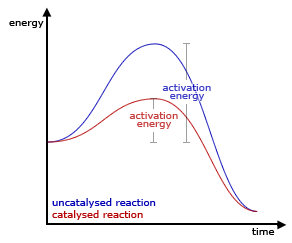
On the simplest level, catalyst make reactions easier. All reactions take a certain amount of energy to move forward and some can be prohibitively slow because the reaction energy needed is so very high. Catalysts allow us to bring this activation energy down to more reasonable levels. Now why would we want to bring the energy level down? This is generally for one simple reasons: energy costs money. Now you might say "But don't catalysts also cost money?" and that's true. They do cost money, but catalyst can often be used for thousands or millions of reactions before they're used up and need to be replaced. Let's go back to the hill analogy. If the tunnel is used to much, it's going to need to be updated and repaired, is it not? Catalysts are the same and can degrade after so much use. That said, if a tunnel allows for thousands of people to travel through the hill rather than over it, it's probably still cheaper than paying to go over the mountain every time. That's why we often use catalysts. Energy is always needed, but whenever they can find a way to use less energy in industry, they're going to do it as long as it saves money. Ultimately, that's why catalysts are so popular. They save money. In industry and for almost all reactions, energy comes from heat. Now if you have a heater in your home, you probably know heating costs money and this is the same for giant industrial size reactions. Heat is the energy used to move a reaction forward and that heat costs money. By using a catalyst, often we can use less heat and thus less energy to let our reaction occur. We get over the hill easier and spend less money doing it.
I'm going to get slightly more technical now about how catalysts actually work (at least beyond my simple analogy) so I apologize in advance if this is very boring. The real way catalysts work is that they generally hold a single molecule such that it is oriented in the perfect way for a reaction to proceed. Last week, I touched on the idea that reactions can be quite difficult. They require molecules to have the perfect orientation and the perfect amount of energy when they collide to form new molecules. Catalysts can catch and hold individual molecules so that the orientation problem is solved. They can hold a molecule such that it already has the perfect orientation for another molecule to come hit it and form a new molecule altogether. Look in the picture below for an example of this. The red dots are molecules that have been "caught" or absorbed by the catalyst and are now being held in place. The purple and green molecule can now come along and easily grab onto one of these little red molecules because they are already being held at the perfect angle. It really is that simple. The math behind is a bit weird. It follows something called the Langmuir Isotherm if you want to look it up and follow that rabbit hole, but the theory of it isn't that bad as you see. Catalysts are often made of very expensive metals like platinum and can take many, many different forms, but even though they may be made with expensive materials, they often save money because they can be used many times as I've explained earlier.

Well I hope that gave you some basic insights into the world of catalysis. It's a pretty cool science and definitely worth investigating on your own if you're interested. I'll see you guys next time!
Image sources:
http://ch302.cm.utexas.edu/kinetics/catalysts/catalysts-all.php
http://intranet.tdmu.edu.te.ua/data/kafedra/internal/zag_him/classes_stud/en/med/lik/ptn/medical%20chemistry/1%20course/06.%20kinetics%20of%20biological%20reaction.htm

No comments:
Post a Comment