This post will be a little bit different than my other ones. I've spent several weeks now talking about many different kinds of things that chemical engineers do in the world. I've talked about the theories they study, the jobs they take, and the many different roles they can take. Today, I want to talk to you about why I became a Chemical Engineer (Chem E is what we call ourselves). I started this blog with the idea of giving a basic insight into chemical engineering. As I said in my very first post, I have many friends of family stat still don't understand what exactly I do. I'll be graduating next spring and I still don't think my parents really know what I study. Hopefully this blog has helped make that a little bit clearer for some. I think by giving my reasoning for pursuing this degree might help others decide if the field is right for them, and beyond that, I hope this post gives some insight into how to pick a major that's right for you.
Now back to the big question? Why did I do it? My answer isn't some big philosophical quandary. It's really actually kind of simple. When i first started college I planned on going to med school. I wanted to be a biochemical engineer (I had no idea what that meant but it sounded cool) and upon enrollment day for my school, I learned we did not offer such a program so I was put down as a chemical engineer with the biotech option. Now my school is actually offering a biochemical engineering program that will start taking students next semester, but it's a little late for me. I stayed in chem E for a semester and then jumped ship for biochemistry, but then almost immediately came back when I learned I would need to take 18 hours of a language in biochemistry and I needed 0 for engineering. Ultimately, I picked chemical engineering because I didn't want to take a language. That's the simple reason how I made my original decision. Now probably the more important question to ask is: "Why did I stay?" Chemical Engineering is an extremely difficult major. You'll work harder than many of your friends in other majors and you'll never be quite sure if the rewards will be worth it in the end. It's a hard field to study. The material is tough, but the pay is generally quite high if you complete the degree. I stayed mostly because I didn't want to be in college for five years and I would have to make up too many classes if I jumped ship late in the game. By first semester, Sophomore year, I was there to stay. It's been a rough ride and I'll be done with it all very soon now. I can't say I've enjoyed all of it or even most of it, but it's been very useful and informative. I've learned many, many skills that I can apply to any job I face. One of the most practical things being a Chem E has done for me is that it's made a master at Excel and VBA. I can make all sorts of advanced spreadsheet and I can write my own functions and macros for those sheets when I have to. I've learned plenty of advanced technical stuff as well and most of it has actually be pretty interesting to me. Looking back on it all, it's really hard to say if I would have done it again. There's safer fields to pick, sure, but if you really like chemistry, but don't want to go into academia or get a PHD just to work in the industry, Chem E is great for you. The material is tough - I really can't stretch that enough, but it's all very useful stuff. You'll definitely feel read for the real world when you get there if you choose Chem E.
That's basically it. I picked it because I didn't want to take a language and I stayed because while it was extremely difficult, the material really resonated with me. I hope that's given you some insight into what it's like to study chemical engineering. I hope it helps!
Sunday, April 24, 2016

Sunday, April 17, 2016
Catalysis
Last week, I spoke about the basics of kinetics and reaction engineering, and I touched on a small sub-set of those fields, Catalysis. I'd like to take the time today to really go into the nitty-gritty (in an easy to access kind of way) of catalysis. Catalysis is put-simply the acceleration of a reaction by by a catalyst, but that really doesn't tell us very much so let's start with a simple analogy. Let's say you need to climb a hill while carrying a heavy backpack full of rocks. No, I have no idea why you're carrying rocks. You're the one doing it. Anyways, you have to get these rocks up the hill and down the other side. Now that's going to take a great deal of energy to do. You can think of this hill as what's called "activation energy" in kinetics. This is the energy it takes to move forward with a reaction. If you don't have enough energy to move over the hill, you aren't going to get to the other side. There are ways to lower that energy required though, aren't there? You could ride a car up (though then you're still using energy but just chemical energy and not yours personally) or you could take a tunnel that happens to cut through the hill so you don't have to climb so far up. This is basically what a catalyst does. It provides a lower energy pathway for a reaction to proceed. Look at the picture below to get a better idea of this. You can see that there is a big hill that needs to be surmounted before you can get the downhill part of your journey. Reactions follow a similar principle where they need enough energy to get to that peak before the reactants have enough energy to change into something else. Now obviously you aren't suddenly going to change into something new once you get over that hill, but you get the point. I guess you could say you're now a "successful hill-climber" if you really want to be something else after climbing the hill. The catalyst is like the tunnel, it creates this lower-energy path for a reaction.
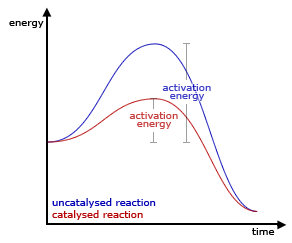
On the simplest level, catalyst make reactions easier. All reactions take a certain amount of energy to move forward and some can be prohibitively slow because the reaction energy needed is so very high. Catalysts allow us to bring this activation energy down to more reasonable levels. Now why would we want to bring the energy level down? This is generally for one simple reasons: energy costs money. Now you might say "But don't catalysts also cost money?" and that's true. They do cost money, but catalyst can often be used for thousands or millions of reactions before they're used up and need to be replaced. Let's go back to the hill analogy. If the tunnel is used to much, it's going to need to be updated and repaired, is it not? Catalysts are the same and can degrade after so much use. That said, if a tunnel allows for thousands of people to travel through the hill rather than over it, it's probably still cheaper than paying to go over the mountain every time. That's why we often use catalysts. Energy is always needed, but whenever they can find a way to use less energy in industry, they're going to do it as long as it saves money. Ultimately, that's why catalysts are so popular. They save money. In industry and for almost all reactions, energy comes from heat. Now if you have a heater in your home, you probably know heating costs money and this is the same for giant industrial size reactions. Heat is the energy used to move a reaction forward and that heat costs money. By using a catalyst, often we can use less heat and thus less energy to let our reaction occur. We get over the hill easier and spend less money doing it.
I'm going to get slightly more technical now about how catalysts actually work (at least beyond my simple analogy) so I apologize in advance if this is very boring. The real way catalysts work is that they generally hold a single molecule such that it is oriented in the perfect way for a reaction to proceed. Last week, I touched on the idea that reactions can be quite difficult. They require molecules to have the perfect orientation and the perfect amount of energy when they collide to form new molecules. Catalysts can catch and hold individual molecules so that the orientation problem is solved. They can hold a molecule such that it already has the perfect orientation for another molecule to come hit it and form a new molecule altogether. Look in the picture below for an example of this. The red dots are molecules that have been "caught" or absorbed by the catalyst and are now being held in place. The purple and green molecule can now come along and easily grab onto one of these little red molecules because they are already being held at the perfect angle. It really is that simple. The math behind is a bit weird. It follows something called the Langmuir Isotherm if you want to look it up and follow that rabbit hole, but the theory of it isn't that bad as you see. Catalysts are often made of very expensive metals like platinum and can take many, many different forms, but even though they may be made with expensive materials, they often save money because they can be used many times as I've explained earlier.

Well I hope that gave you some basic insights into the world of catalysis. It's a pretty cool science and definitely worth investigating on your own if you're interested. I'll see you guys next time!
Image sources:
http://ch302.cm.utexas.edu/kinetics/catalysts/catalysts-all.php
http://intranet.tdmu.edu.te.ua/data/kafedra/internal/zag_him/classes_stud/en/med/lik/ptn/medical%20chemistry/1%20course/06.%20kinetics%20of%20biological%20reaction.htm
Sunday, April 10, 2016
Kinetics and Reaction Engineering
So last week I dealt with separations, which one of the most important parts of chemical engineering and is extremely important throughout industry. Separations isn't the only part of major chemical processes though. If you ever see a chemical plant, you'll probably see lots of tall separation towers, but if you look closely there will be much smaller buildings that are also extremely important to chemical processes. These are chemical reactors. Though are often pretty small compared to separation towers that can easily be hundreds of feet tall, they're no less important. It's very rare in the chemical industry that the desired product is already in the form required to take to market. Most often, plants take in raw materials and use the reactors to create the desired products or sometimes, reactions occur and the products themselves must be further reacted because they are highly toxic. Probably the most common example of this is combustion, the process of taking in various carbon molecules and burning them in the presence of oxygen to produce carbon dioxide and water:  . This reaction is involved in everything. Every time you burn wood for a fire, it's this reaction that's occurring, though normally the carbon molecule will contain several hydrogen molecules as well and carbon dioxide won't be the only product. Now, this reaction assumes perfect combustion and it's great for teaching the basics of reactions in chemistry classes, but often carbon dioxide and water are not the only products. Many combustion reactions are called "incomplete" and this means they produce products other than just carbon dioxide and water and these other products can often be very dangerous gases. For example, incomplete combustion can create methane (CH4 and various sulfur and nitrogen molecules). The problem with these chemicals is that they are very powerful greenhouse gases - must more dangerous than just carbon dioxide. There are ways of getting rid of these gases though before they're released to the atmosphere. Everyday cars produce billions of tons of carbon dioxide and yet relatively little extremely dangerous greenhouse gases and this is because of the catalytic converter in the vehicle. Catalysis is a way of reducing the amount of energy needed for a reaction to occur and the catalytic converter in a car allows for the highly toxic greenhouse gases to react and form much less dangerous products. See the picture below for a basic diagram of this process.


. This reaction is involved in everything. Every time you burn wood for a fire, it's this reaction that's occurring, though normally the carbon molecule will contain several hydrogen molecules as well and carbon dioxide won't be the only product. Now, this reaction assumes perfect combustion and it's great for teaching the basics of reactions in chemistry classes, but often carbon dioxide and water are not the only products. Many combustion reactions are called "incomplete" and this means they produce products other than just carbon dioxide and water and these other products can often be very dangerous gases. For example, incomplete combustion can create methane (CH4 and various sulfur and nitrogen molecules). The problem with these chemicals is that they are very powerful greenhouse gases - must more dangerous than just carbon dioxide. There are ways of getting rid of these gases though before they're released to the atmosphere. Everyday cars produce billions of tons of carbon dioxide and yet relatively little extremely dangerous greenhouse gases and this is because of the catalytic converter in the vehicle. Catalysis is a way of reducing the amount of energy needed for a reaction to occur and the catalytic converter in a car allows for the highly toxic greenhouse gases to react and form much less dangerous products. See the picture below for a basic diagram of this process.
Combustion is far from the only type of reaction we see in our daily lives. Reactions are everywhere and it can be very useful to know about them. Cooking is probably one of the most common forms of chemical reactions we produce everyday. Most cooking relies on breaking up large protein molecules into smaller and more digestible amino acids. The heating also denatures bacteria and kills parasites that might be present in the food. Now there's a particular reaction that's extremely important for making delicious meats and other foods: the Maillard reaction, commonly called caramelization. This is the reaction that produces that brown-colored skin you see on grilled meats and vegetables. Basically we take amino acids, and sugars present in the raw ingredients and when we add heat, a compound called GBD is formed and this is the chemical responsible for that delicious dark-brown skin we see on grilled food.
Now I've touched on some basic reactions that we see in our day to day lives but now I'm going to discuss some of the actual important technical details (I apologize in advance if this is too boring). As I've said, Kinetics is the study of chemical reactions and every reaction out there varies massively from others. Some are slow and some are extremely fast. If you add NaCl (table salt) to water, it nearly instantly dissociates into it's component ions of sodium and chlorine. This is because this reaction has a very low activation energy and activation energy is the energy needed for a reaction to move forward. There are plenty of extremely slow chemical reactions though. The combination of hydrogen and oxygen gases to form water is a very slow reaction and can take months to form even a single water molecule. There are several reasons that this reaction is very slow. It takes a great deal of energy to cause this reaction, and it also is very rare for two gas molecules to hit one another at the perfect angle, Gases are made up of more than trillions of tiny molecules bouncing around at extremely fast speeds, but they very rarely hit one another in atmospheric conditions and even when they do hit one another, they may not have the proper orientation to react and create a new chemical and even when they do hit at the right orientation, they may lack enough energy to react. Now there we can speed up slow reactions by heating them up or by adding a catalyst. The heat helps provide more energy and thus means more molecules have sufficient energy to react and a catalyst (like platinum) can help lower the needed activation energy by helping orient the molecules properly. The catalyst basically holds one molecule in a specific orientation such that it can react much easier.
Chemical engineering relies on kinetics and reactions every day around the world in productions plants making all kinds of different products that we use. Now that doesn't mean not everyone can create their own chemical reactions at home. There are plenty of fun chemical reaction experiments you can do at home like instantly freezing water, turning pennies into gold (not actually gold, but gold colored), or waterproofing sand and here's a link of 20 different fun experiments you can try at home. Enjoy and make sure you follow any safety precautions needed!
Image sources
https://www.google.com/url?sa=i&rct=j&q=&esrc=s&source=images&cd=&cad=rja&uact=8&ved=0ahUKEwjzqL-GkIXMAhWB2SYKHV9NAHsQjB0IBg&url=http%3A%2F%2Famazingribs.com%2Ftips_and_technique%2Fmaillard_reaction_and_caramelization.html&psig=AFQjCNG2n9G2HbzLKwk4Y-sKM-8NQ0_gpg&ust=1460413213782449
https://www.google.com/url?sa=i&rct=j&q=&esrc=s&source=images&cd=&cad=rja&uact=8&ved=0ahUKEwifrM6dkIXMAhVGYiYKHcGjCTIQjB0IBg&url=http%3A%2F%2Fwww.autoexcellenceonline.com%2Fcatalytic-converter.html&psig=AFQjCNHeZMiHHdQKyc_M9hYuSm50SDIqBA&ust=1460413995825426
Sunday, April 3, 2016
Separations
Today I'm going
to be discussing a little topic that is extremely important in chemical
engineering and that is separations. Separations is basically exactly what the
name implies but it goes into massive depth in the field of chemical
engineering. I personally am taking a class right now that just serve as an
intro into separations and it's extremely difficult and complicated already. On
the most basic level, separation processes are processes by which things are separated
from other things. Now that seems pretty redundant and almost meaningless so
let’s get a bit more specific. A few weeks ago, I talked about distillation.
Distillation is a specific type of separation and there are even many
subsections of distillation that are further divided into more specific types
of distillation (tray, flash, etc. and there are even subdivisions of these
types honestly).
So we’ve got one example of separations. But what other kinds are
there out there? Let’s go with something simple and then expand it a bit to an
industry example: filters. Filters are everywhere around you. They’re in the
air intake vents in your house or apartment, on your AC unit, in your fridge,
in your Brita, everywhere. Basically, filters are a way of separating things
based on the size of the particles involved. You could separate rocks from
water with a towel, or cheese from whey with cheesecloth and you’d be filtering
in each case. Now let’s look at a specific industry example of filtration. You
may have heard of reverse osmosis from somewhere or another. It’s a filtration
process that relies on specific membranes through which water molecules (and
anything smaller) can pass through unhindered while bigger particles (dirt,
salt, or metals) cannot. Reverse osmosis is extremely useful in regions that
don’t have access to freshwater because it can turn saltwater into drinkable
water. Now there are major downsides to reverse osmosis – it is extremely
energy intense and thus is really only optimal for places without access to
freshwater from other sources. That is not to say that it’s not an incredibly
powerful separation method though. For most of human history, the only way to
separate salt from water was to evaporate it and re-condense the evaporated
water in another container. This is time consuming and very difficult. Reverse
osmosis is continuous and freshwater can be continually generated as the
process goes. See the below picture for a very basic diagram of this process.
It’s just like any other filtration. You’re relying on the fact that smaller
particles will fit through smaller holes while larger ones will not. Now filtration
can be a little more complicated a times – filters can also rely on differences
in chemical or electric properties to remove impurities rather than just pores.

Filtration is just one example of separations though. The field is
quite possibly endless and that’s why I’m going to try to go into just some of
the biggest ones here and give enough depth to show why they’re each important.
Let’s move on to absorption and stripping (not that kind of stripping).
Absorption and stripping are extremely common methods for liquid-liquid,
liquid-gas, or gas-gas separations. The idea is that two streams can be passed
by one another where one stream contains a contaminant that we want to remove
and the other stream will be pure but used to absorb some of the unwanted
material. So say we have some methanol vapor (very bad stuff to consume) contamination
in an air sample and we want to remove it so that we can use the air for
medical purposes. We could use a water stream running counter-current (in the
opposite direction) of the gas stream in a separation unit to pull out the
methanol and purify the air so that it’s safe to use. The methanol gets caught
up in the water much more easily than it does in the air and so as the streams
pass one another, methanol is pulled into the liquid, while the air stream is purified
and passes through the other side. The methanol is now in the liquid phase and
though methanol-water is very hard to separate, it is much less dangerous in its
liquid form than its vapor form. You still shouldn’t drink it though. Methanol
is extremely dangerous and can cause you go to blind in even very small
amounts. It has its uses though. Methanol-water (the mixture of the two) is a
very good solvent and is often used in analytical chemistry.
In industry, separations are easily the most important part of any
chemical production processes. In any process, there are unwanted byproducts
and contaminants that must be removed before they can be taken to market. If
you ever drive past a refinery, the tallest towers you see are the separation
towers and they’re the most expensive component on-site because they’re extremely
important. You can’t sell your gasoline if it has water in it or you’re oxygen
if it’s contaminated with borane gas. You have to separate out the unwanted
components. Now you can never truly get pure separations (100% of one thing).
There will always be some small contaminants. That’s why you shouldn’t freak
out when you hear there’s arsenic in the water. There’s arsenic in all water
but in your drinking water, the amounts are generally of no concern. There can
be cases where the contaminants exceed acceptable levels and then separations
must be done. Look at Flint, Michigan for example. Due to improper handling
with the switch over from Detroit’s water supply to lake water, the acidity of
the lake water caused corrosion in the old lead pipes and now lead has been
seeded into the water supply. To remove this lead, you need a high grade filter
specifically designed for heavy metal filtration. I should also point out that
again, having a tiny amount of lead in the water is not dangerous. All water
around the world contains some small amount of lead but the amounts are
generally so small as to be no concern (I’m talking about parts per trillion,
and not parts per million – PPM is generally a common measure for the amount of
contaminant in something). All that said, being able to separate contaminants
from the target product is extremely important not only to big companies but
also to individuals.
There are easily hundreds of different types of separations and I’ve
only just gone over a few of them today. Many of them are very complicated and
a bit hard to explain in layman’s terms. For example if you really want to go
down the rabbit hole for separations, lookup “tray hydraulic distillation” or “packed
tower” for some really dry and technical (though extremely meaningful) reading.
For most of us, we would never even use the word separation processes to
describe the kinds of things we do that might fit under that heading. We filter
stuff, we boil off stuff, we absorb stuff, but all of those things fall into the
field of separations. Almost ever drink you’ve ever had was probably separated
somewhere in the production line. Fruit juices are separated from pulp via
filtration. Salt can be separated from salt water via boiling to make sea salt
and if you re-condense the air, pure drinking water. I’ve included some interesting
links below that the kids might want to check out if you want to try some basic
separations experiments at home. I hope I’ve done an acceptable job of
introducing the field of separations to you guys. If you have any questions or
want to see a specific topic, post it in the comments and I’ll talk about it
next time.
http://www.rsc.org/learn-chemistry/resource/res00000386/separating-sand-and-salt?cmpid=CMP00005908
Image source
http://puretecwater.com/what-is-reverse-osmosis.html
Sunday, March 27, 2016
Make your own wine
So a few weeks back, I prepared instructions on how to make your own wine and I've decided to share those instructions with you guys. This probably would have gone better with my posts on alcohol, but better late than never. There's a set with images as well at the bottom. Just follow the link. Currently blogger wont allow me to post in the images. I have to upload them directly and I no longer have them saved as individual images anywhere. Enjoy!
How to Make Wine
So you’re interested in making your own wine? Wine has been
made for thousands of years and is really quite simple and easy to make. Wine
is the simply result of allowing the fermentation of fruit sugars by yeast over
an extended time period. It relies on very simple principles of chemical
engineering and chemistry: the first being batch reactors, that is a tank or
any other reactor that you add all of your components to and close until the
reaction has completed, and second, desorption, whereby something is dissolved
in something else. Here, we will be dissolving sugar and carbon dioxide into
water. Now wine making takes some time,
so you’ll need to be prepared to wait at least one month before your wine is
done and make sure you have a cool, dark place to place it while it ferments.
Now let’s get started. First you’ll need a few things.
Materials:
Gallon jug of water
Air lock (balloon)
Tooth pick
Frozen fruit juice concentrate (pick a flavor)
Sugar (at least 2 cups)
Yeast – ¼ oz - (Brewers is ideal, but bakers’ or rapid rise
yeast works too).
Pot that can hold half a gallon of water.
Stove or hot plate
Funnel
Sharpie or other permanent marker
Rubber band
Warnings:
Be careful pouring hot liquid.
Wipe down any spills with soap and water. The sugar water
will harden and can crystalize if not cleaned up.
Instructions:
1.
Empty half of the gallon jug of water into the
pot. Pour out an additional four cups of water and dispose of this.
2.
Heat the water to just shy of boiling, where the
first bubbles are starting to form.
3.
Add 2-4 cups of sugar to the pot. If you are
using a very sour juice concentrate (grapefruit or lime) use more sugar (3-4
cups). If you are using a sweet concentrate (strawberry, apple, etc.) use less
(2-3). Varying the sugar amount also determines the dryness of the wine. More
sugar = sweeter wine (moscato, Riesling). Less sugar = dryer wine (Beardoiux,
Cabernet). This will take some fine tuning to find your preference. Start with
less. You can add more after the fermentation process has completed.
4.
Keep heating the water-sugar mixture over medium
heat until the sugar dissolves, stirring continuously. The liquid should be
completely clear.
5.
Once the sugar has dissolved, use the funnel and
oven mitts to pour half of the hot water back into the gallon jug. Be careful
not to spill.
6.
Pour the frozen juice concentrate into the
funnel, using the remaining hot water to melt any large frozen chunks.
7.
Use remaining hot sugar-water to bring water
level up to two to three inches below the top of the jug.
8.
Let water cool for five minutes. You want it to
be warm, but not outright hot. Aim for 80-110 degrees Fahrenheit but it doesn’t
have to be exact. Yeast likes warm water, not hot water.
9.
Pour out a small glass of the mixture and taste
it. If it is unbearably sweet, you will probably want to start over. If it
tastes close to fruit juice but just a little bit sweeter, you’re right on
track for a nice slightly sweet wine. If it is extremely bitter or sour and you
don’t want a very dry wine, dissolve some more sugar in hot water and add to
the batch. This is why we don’t fill the jug all the way on the first try.
10.
Add one packet of yeast. Cap and shake to mix.
11.
Stab the toothpick through both sides of the
balloon. You now have your airlock. The fermentation process produces carbon
dioxide gas and this gas builds up inside and could cause the system to explode
if it was unable to vent and thus it must be allowed to escape. We also don’t
want to allow other gases or bacteria to get inside and spoil the batch and so
the balloon can expand and the pressure of the carbon dioxide on the inside
will prevent exterior gases from entering and the small holes will keep the
internal pressure from getting too high.
12.
Stretch the balloon over the mouth of the jug,
using the rubber band to secure it in place.
13.
Write the date and the name of your wine on the
side of the jug. Store in a cool, dry place like under the sink or in a cabinet.
Keep the cap with the jug. We’re going to need it eventually.
14.
Wait at least one month. Longer waiting times
makes for dryer and stronger wine. You should be able to see the balloon
inflate and slowly deflate over weeks. This is good. The yeast are busy turning
the sugar into alcohol. You can also sample the wine and put it back to keep
fermenting. You can add more sugar if you want it sweeter.
15.
After your chosen time period has passed. Open
your wine. Throw away the balloon and rubber band. Pour out a glass and sample
your wine. If it’s good, great! If not, just try again. Wine making is a
process. The first time I tried, I made several batches at once to figure out
what worked best and you may want to do the same. It only costs about two to three
dollars per gallon of wine so don’t worry if one batch fails. Experiment and
see what works for you!
(Optional) There will be some
cloudy liquid at the bottom of your wine. These are called leets and are
basically the dead yeasts leftover in the wine. They are safe to drink, but
some people don’t like their appearance. To remove them, filter your wine
through several layers of paper towels 4-5 times and allow the liquid to settle
after each filtration. You can also just decant the clear liquid off the top
with a syringe if you would like to avoid filtering but still want clear wine.
Congratulations you made your first homemade wine! Now that you’ve finished one, try other
flavors. One of the best wines I’ve made was from passionfruit concentrate and
it tasted like a dry sherry. You can add fruit, nuts and herbs to your wines
before fermentation to add some unique notes to your final product. You can
also add flavors after the wine has finished fermenting like lemon extract or
some red food coloring to give your wine a darker, fuller color. Really just have fun, try some new things, and
enjoy!
And here's the link if you want to see the images too: https://drive.google.com/file/d/0B6zFeNnwhshdb0tyLUppdEprTm8/view?usp=sharing
Sunday, March 20, 2016
Materials Science
So today's post is going to take a slightly different
route. Instead of discussing another element or example of chemical
engineering, I'm going to discuss a related field that many chemical engineers
often find work in - materials science and materials engineering. This topic is
particularly interesting to me because I am considering pursuing a graduate
study in materials engineering. Basically, materials science and materials
engineering is based on the ideas of how things are made and what they're made
of. A car engine and a spoon may both be made with metals but the types of
metals used have quite a few differences. Even the same metals can have different
properties when used for different application. A cold metal behaves
differently from a hot one and a thick piece metal is different from a thin
one.
Materials science goes back thousands of years even if the
field was not technically called materials science. Historically, materials
science would probably be more traditionally known
as blacksmithing or metallurgy and the science behind these fields
was not entirely understood for most their history. Even without knowing
the little details about making alloys, blacksmiths and metallurgists for
millennia have known that if you heat iron to extreme temperatures in the
presence of coke (carbon, not the soda) that you can get steel. Carbon-steel
has been one of (if not the) most important discoveries in history and it is
still extremely important in almost all fields today. If you look around
yourself, you can probably find several things made of or made with carbon
steel. This could be the screws in the chair you’re sitting in, your nail
clippers, or the body of your lamp. It’s everywhere and that’s because
carbon-steel does two things very well. It is very strong, but is also fairly
malleable – that is, it won’t crack and shatter. It’s slightly flexible and
thus is great for building things out of. Those massive cables that run over
the Golden Gate Bridge are an excellent example of these two traits. Carbon
steel cables can be bent and wound together in a braid to make an even stronger
and larger cable similar to how you might braid together smaller ropes to make
a bigger one. Unlike, rope though, steel cables are extremely strong and yet
they can still bend slightly. High winds can cause the bridge to distort small
amounts, changes in heat can cause compression and expansion. Carbon-steel
cables can absorb this kind of movement without breaking and that’s why it’s so
important. If we were to build those cables with something less malleable like
hard ceramics, the cables would still be very strong, but they wouldn’t be able
to bend and absorb shock. They would just shatter.
Modern materials science research is heavily focused on the
idea of nano and lower-dimensional materials as well super lightweight
materials. You may have heard of Graphene, “the miracle material that can
do everything but leave the lab”. Now Graphene is just one example of a
nano-material. Graphene is basically an extremely thin sheet of carbon, so thin
in-fact that it’s only one atom thick. It’s basically a sheet of atoms. Now
what scientists have found with this is that this sheet of carbon atoms behaves
very differently from other forms of carbon. It is quite strong, it can be used
to conduct electricity, and it’s extremely lightweight. It’s so thin, we can
almost call one dimensional. Graphene isn’t the only really cool material that modern
scientists are working on though. There’s also carbon nanotubes, which, like
graphene are one atom thick but they are tubes of carbon rather than sheets.
These tubes have been proposed for thousands of different uses but their
development is still quite young and thus many of their uses are not fully
mapped out at this point. They could eventually be used for drug delivery,
nanobots, microscopic surgeries and a myriad of other things. Even with all
these scientists focusing on really small materials, other scientists are
focusing on slightly bigger things that weigh very little. One great example of
this is Aereogel. It’s a super lightweight material – that is a block the size
of a car would weigh less than a pound and yet it is still quite strong. Again,
this is a very young development but research programs like NASA are
investigating the material for potential use in space applications. Lightweight
materials are very important in space travel as most of the fuel used in space
travel is used in getting out of earth’s atmosphere and thus saving any weight
at all reduces the amount of fuel needed.
So these are just some basic examples of materials science
and engineering. It’s the science of making and understanding the things that
make up everything and there’s a good chance almost every item you use in your
day to day life has probably at one point been worked on by a materials
scientists or engineer. It’s an extremely important field and one where many
chemical engineers often find themselves. I, myself am certainly considering
such a field.
Monday, March 14, 2016
Gasoline
So if you've seen the new documentary, Mad Max: Fury Road or the originals, you'll know that even if the world ended today, gasoline (or guzzoline) would still be very important to society. While the world still hasn't ended, if you'll just look around you can probably spot a car or two without trying that hard. Gas and oil-products are everywhere and this post will specifically focus on the production of gasoline from raw crude oil, a process known as cracking. Cracking is based in the chemical engineering process of chemical separation, specifically the process of cracking is a modified form of distillation. Now I'm going to have to go into some of the basics of organic chemistry for this to make sense but basically crude oil is a mixture of various lengths of chain made of carbon atoms surrounded by hydogren as seen below.

Basically crude oil starts with mostly longer chains of carbon and then through cracking (which can be heat based or catalytic), the chains break into smaller chains. Generally crude oil is comprised of very long chains (50-100 carbons long) and the cracking process is useful for breaking these into smaller, more sought-after chain lengths. Steam heating is generally the most common where super-heated steam is used to provide heat to trays inside of a distillation column. By setting the temperature of the rising trays to be slightly lower than each one below them, the cracked components can filter out at each stage. Basically, the shorter carbon chains are lighter and will float higher in the column, Think about how liquid water will sit in a pot while steam from it will rise up. Something very similar is happening here except instead of just water molecules, the molecules have different lengths here. As the feed is cracked in the column, various outlets are used to collect varying components. You'll see things like heating oil or diesel on lower levels of the tower and near the top, you'll get some of the lighter components like gasoline (octane) or natural gas (a mixture of methane, ethane, and propane).

You may have noticed that when you buy gas at the station, there's usually three buttons with different numbers for the octane rating. Octane is a chain of eight carbon molecules and additives such as branched or cyclic alkanes are added to the processed fuel to prevent the octane chains from bonding up with other chains again. The reason that the higher octane fuel costs more is because it is more expensive to separate fuel into purer concentrations of octane. Simply cracking and distilling may not be enough to create pure enough feeds for high octane fuels. To get purer fuels, further separation may required where desiccants may be used to absorb undesirables or a membrane filter may be used to further remove any larger molecules than the octane. As you approach 100% octane, it gets harder and harder to remove the other components and thus it makes sense that 95% octane fuel would costs more than 85% octane fuel. Though the actual octane number you see on a gas pump isn't actually a percentage, it is a metric used to define the performance of the fuel for gasoline engines, but the higher number still generally refers to higher concentrations of octane.
And that's basically how you get gasoline. You start with thick crude oil, heat it, or break it up with a catalyst, and you get smaller and smaller chains of carbon. If you want carbon chains that are eight carbons long, then you want to extract the octane. If you want lighter fuel still like propane or methane, then you will need more separations trays to get lighter and lighter outlet components. The more trays you have, the more separated the higher components will be from the lower ones. It's arguably one of the most important chemical processes in the world today and many chemical engineers find themselves working on process design and management in the oil industry where they'll oversee the cracking process and the distillation columns it occurs in.
Image sources:
http://www.bbc.co.uk/schools/gcsebitesize/science/21c/materials_choices/crude_oil_usesrev2.shtml
http://www.bbc.co.uk/schools/gcsebitesize/science/aqa_pre_2011/rocks/fuelsrev3.shtml
Basically crude oil starts with mostly longer chains of carbon and then through cracking (which can be heat based or catalytic), the chains break into smaller chains. Generally crude oil is comprised of very long chains (50-100 carbons long) and the cracking process is useful for breaking these into smaller, more sought-after chain lengths. Steam heating is generally the most common where super-heated steam is used to provide heat to trays inside of a distillation column. By setting the temperature of the rising trays to be slightly lower than each one below them, the cracked components can filter out at each stage. Basically, the shorter carbon chains are lighter and will float higher in the column, Think about how liquid water will sit in a pot while steam from it will rise up. Something very similar is happening here except instead of just water molecules, the molecules have different lengths here. As the feed is cracked in the column, various outlets are used to collect varying components. You'll see things like heating oil or diesel on lower levels of the tower and near the top, you'll get some of the lighter components like gasoline (octane) or natural gas (a mixture of methane, ethane, and propane).
You may have noticed that when you buy gas at the station, there's usually three buttons with different numbers for the octane rating. Octane is a chain of eight carbon molecules and additives such as branched or cyclic alkanes are added to the processed fuel to prevent the octane chains from bonding up with other chains again. The reason that the higher octane fuel costs more is because it is more expensive to separate fuel into purer concentrations of octane. Simply cracking and distilling may not be enough to create pure enough feeds for high octane fuels. To get purer fuels, further separation may required where desiccants may be used to absorb undesirables or a membrane filter may be used to further remove any larger molecules than the octane. As you approach 100% octane, it gets harder and harder to remove the other components and thus it makes sense that 95% octane fuel would costs more than 85% octane fuel. Though the actual octane number you see on a gas pump isn't actually a percentage, it is a metric used to define the performance of the fuel for gasoline engines, but the higher number still generally refers to higher concentrations of octane.
And that's basically how you get gasoline. You start with thick crude oil, heat it, or break it up with a catalyst, and you get smaller and smaller chains of carbon. If you want carbon chains that are eight carbons long, then you want to extract the octane. If you want lighter fuel still like propane or methane, then you will need more separations trays to get lighter and lighter outlet components. The more trays you have, the more separated the higher components will be from the lower ones. It's arguably one of the most important chemical processes in the world today and many chemical engineers find themselves working on process design and management in the oil industry where they'll oversee the cracking process and the distillation columns it occurs in.
Image sources:
http://www.bbc.co.uk/schools/gcsebitesize/science/21c/materials_choices/crude_oil_usesrev2.shtml
http://www.bbc.co.uk/schools/gcsebitesize/science/aqa_pre_2011/rocks/fuelsrev3.shtml
Subscribe to:
Posts (Atom)