This post will be a little bit different than my other ones. I've spent several weeks now talking about many different kinds of things that chemical engineers do in the world. I've talked about the theories they study, the jobs they take, and the many different roles they can take. Today, I want to talk to you about why I became a Chemical Engineer (Chem E is what we call ourselves). I started this blog with the idea of giving a basic insight into chemical engineering. As I said in my very first post, I have many friends of family stat still don't understand what exactly I do. I'll be graduating next spring and I still don't think my parents really know what I study. Hopefully this blog has helped make that a little bit clearer for some. I think by giving my reasoning for pursuing this degree might help others decide if the field is right for them, and beyond that, I hope this post gives some insight into how to pick a major that's right for you.
Now back to the big question? Why did I do it? My answer isn't some big philosophical quandary. It's really actually kind of simple. When i first started college I planned on going to med school. I wanted to be a biochemical engineer (I had no idea what that meant but it sounded cool) and upon enrollment day for my school, I learned we did not offer such a program so I was put down as a chemical engineer with the biotech option. Now my school is actually offering a biochemical engineering program that will start taking students next semester, but it's a little late for me. I stayed in chem E for a semester and then jumped ship for biochemistry, but then almost immediately came back when I learned I would need to take 18 hours of a language in biochemistry and I needed 0 for engineering. Ultimately, I picked chemical engineering because I didn't want to take a language. That's the simple reason how I made my original decision. Now probably the more important question to ask is: "Why did I stay?" Chemical Engineering is an extremely difficult major. You'll work harder than many of your friends in other majors and you'll never be quite sure if the rewards will be worth it in the end. It's a hard field to study. The material is tough, but the pay is generally quite high if you complete the degree. I stayed mostly because I didn't want to be in college for five years and I would have to make up too many classes if I jumped ship late in the game. By first semester, Sophomore year, I was there to stay. It's been a rough ride and I'll be done with it all very soon now. I can't say I've enjoyed all of it or even most of it, but it's been very useful and informative. I've learned many, many skills that I can apply to any job I face. One of the most practical things being a Chem E has done for me is that it's made a master at Excel and VBA. I can make all sorts of advanced spreadsheet and I can write my own functions and macros for those sheets when I have to. I've learned plenty of advanced technical stuff as well and most of it has actually be pretty interesting to me. Looking back on it all, it's really hard to say if I would have done it again. There's safer fields to pick, sure, but if you really like chemistry, but don't want to go into academia or get a PHD just to work in the industry, Chem E is great for you. The material is tough - I really can't stretch that enough, but it's all very useful stuff. You'll definitely feel read for the real world when you get there if you choose Chem E.
That's basically it. I picked it because I didn't want to take a language and I stayed because while it was extremely difficult, the material really resonated with me. I hope that's given you some insight into what it's like to study chemical engineering. I hope it helps!
Sunday, April 24, 2016

Sunday, April 17, 2016
Catalysis
Last week, I spoke about the basics of kinetics and reaction engineering, and I touched on a small sub-set of those fields, Catalysis. I'd like to take the time today to really go into the nitty-gritty (in an easy to access kind of way) of catalysis. Catalysis is put-simply the acceleration of a reaction by by a catalyst, but that really doesn't tell us very much so let's start with a simple analogy. Let's say you need to climb a hill while carrying a heavy backpack full of rocks. No, I have no idea why you're carrying rocks. You're the one doing it. Anyways, you have to get these rocks up the hill and down the other side. Now that's going to take a great deal of energy to do. You can think of this hill as what's called "activation energy" in kinetics. This is the energy it takes to move forward with a reaction. If you don't have enough energy to move over the hill, you aren't going to get to the other side. There are ways to lower that energy required though, aren't there? You could ride a car up (though then you're still using energy but just chemical energy and not yours personally) or you could take a tunnel that happens to cut through the hill so you don't have to climb so far up. This is basically what a catalyst does. It provides a lower energy pathway for a reaction to proceed. Look at the picture below to get a better idea of this. You can see that there is a big hill that needs to be surmounted before you can get the downhill part of your journey. Reactions follow a similar principle where they need enough energy to get to that peak before the reactants have enough energy to change into something else. Now obviously you aren't suddenly going to change into something new once you get over that hill, but you get the point. I guess you could say you're now a "successful hill-climber" if you really want to be something else after climbing the hill. The catalyst is like the tunnel, it creates this lower-energy path for a reaction.
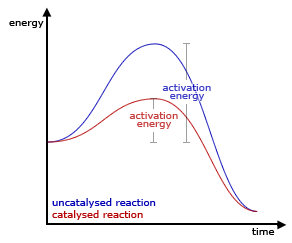
On the simplest level, catalyst make reactions easier. All reactions take a certain amount of energy to move forward and some can be prohibitively slow because the reaction energy needed is so very high. Catalysts allow us to bring this activation energy down to more reasonable levels. Now why would we want to bring the energy level down? This is generally for one simple reasons: energy costs money. Now you might say "But don't catalysts also cost money?" and that's true. They do cost money, but catalyst can often be used for thousands or millions of reactions before they're used up and need to be replaced. Let's go back to the hill analogy. If the tunnel is used to much, it's going to need to be updated and repaired, is it not? Catalysts are the same and can degrade after so much use. That said, if a tunnel allows for thousands of people to travel through the hill rather than over it, it's probably still cheaper than paying to go over the mountain every time. That's why we often use catalysts. Energy is always needed, but whenever they can find a way to use less energy in industry, they're going to do it as long as it saves money. Ultimately, that's why catalysts are so popular. They save money. In industry and for almost all reactions, energy comes from heat. Now if you have a heater in your home, you probably know heating costs money and this is the same for giant industrial size reactions. Heat is the energy used to move a reaction forward and that heat costs money. By using a catalyst, often we can use less heat and thus less energy to let our reaction occur. We get over the hill easier and spend less money doing it.
I'm going to get slightly more technical now about how catalysts actually work (at least beyond my simple analogy) so I apologize in advance if this is very boring. The real way catalysts work is that they generally hold a single molecule such that it is oriented in the perfect way for a reaction to proceed. Last week, I touched on the idea that reactions can be quite difficult. They require molecules to have the perfect orientation and the perfect amount of energy when they collide to form new molecules. Catalysts can catch and hold individual molecules so that the orientation problem is solved. They can hold a molecule such that it already has the perfect orientation for another molecule to come hit it and form a new molecule altogether. Look in the picture below for an example of this. The red dots are molecules that have been "caught" or absorbed by the catalyst and are now being held in place. The purple and green molecule can now come along and easily grab onto one of these little red molecules because they are already being held at the perfect angle. It really is that simple. The math behind is a bit weird. It follows something called the Langmuir Isotherm if you want to look it up and follow that rabbit hole, but the theory of it isn't that bad as you see. Catalysts are often made of very expensive metals like platinum and can take many, many different forms, but even though they may be made with expensive materials, they often save money because they can be used many times as I've explained earlier.

Well I hope that gave you some basic insights into the world of catalysis. It's a pretty cool science and definitely worth investigating on your own if you're interested. I'll see you guys next time!
Image sources:
http://ch302.cm.utexas.edu/kinetics/catalysts/catalysts-all.php
http://intranet.tdmu.edu.te.ua/data/kafedra/internal/zag_him/classes_stud/en/med/lik/ptn/medical%20chemistry/1%20course/06.%20kinetics%20of%20biological%20reaction.htm
Sunday, April 10, 2016
Kinetics and Reaction Engineering
So last week I dealt with separations, which one of the most important parts of chemical engineering and is extremely important throughout industry. Separations isn't the only part of major chemical processes though. If you ever see a chemical plant, you'll probably see lots of tall separation towers, but if you look closely there will be much smaller buildings that are also extremely important to chemical processes. These are chemical reactors. Though are often pretty small compared to separation towers that can easily be hundreds of feet tall, they're no less important. It's very rare in the chemical industry that the desired product is already in the form required to take to market. Most often, plants take in raw materials and use the reactors to create the desired products or sometimes, reactions occur and the products themselves must be further reacted because they are highly toxic. Probably the most common example of this is combustion, the process of taking in various carbon molecules and burning them in the presence of oxygen to produce carbon dioxide and water:  . This reaction is involved in everything. Every time you burn wood for a fire, it's this reaction that's occurring, though normally the carbon molecule will contain several hydrogen molecules as well and carbon dioxide won't be the only product. Now, this reaction assumes perfect combustion and it's great for teaching the basics of reactions in chemistry classes, but often carbon dioxide and water are not the only products. Many combustion reactions are called "incomplete" and this means they produce products other than just carbon dioxide and water and these other products can often be very dangerous gases. For example, incomplete combustion can create methane (CH4 and various sulfur and nitrogen molecules). The problem with these chemicals is that they are very powerful greenhouse gases - must more dangerous than just carbon dioxide. There are ways of getting rid of these gases though before they're released to the atmosphere. Everyday cars produce billions of tons of carbon dioxide and yet relatively little extremely dangerous greenhouse gases and this is because of the catalytic converter in the vehicle. Catalysis is a way of reducing the amount of energy needed for a reaction to occur and the catalytic converter in a car allows for the highly toxic greenhouse gases to react and form much less dangerous products. See the picture below for a basic diagram of this process.


. This reaction is involved in everything. Every time you burn wood for a fire, it's this reaction that's occurring, though normally the carbon molecule will contain several hydrogen molecules as well and carbon dioxide won't be the only product. Now, this reaction assumes perfect combustion and it's great for teaching the basics of reactions in chemistry classes, but often carbon dioxide and water are not the only products. Many combustion reactions are called "incomplete" and this means they produce products other than just carbon dioxide and water and these other products can often be very dangerous gases. For example, incomplete combustion can create methane (CH4 and various sulfur and nitrogen molecules). The problem with these chemicals is that they are very powerful greenhouse gases - must more dangerous than just carbon dioxide. There are ways of getting rid of these gases though before they're released to the atmosphere. Everyday cars produce billions of tons of carbon dioxide and yet relatively little extremely dangerous greenhouse gases and this is because of the catalytic converter in the vehicle. Catalysis is a way of reducing the amount of energy needed for a reaction to occur and the catalytic converter in a car allows for the highly toxic greenhouse gases to react and form much less dangerous products. See the picture below for a basic diagram of this process.
Combustion is far from the only type of reaction we see in our daily lives. Reactions are everywhere and it can be very useful to know about them. Cooking is probably one of the most common forms of chemical reactions we produce everyday. Most cooking relies on breaking up large protein molecules into smaller and more digestible amino acids. The heating also denatures bacteria and kills parasites that might be present in the food. Now there's a particular reaction that's extremely important for making delicious meats and other foods: the Maillard reaction, commonly called caramelization. This is the reaction that produces that brown-colored skin you see on grilled meats and vegetables. Basically we take amino acids, and sugars present in the raw ingredients and when we add heat, a compound called GBD is formed and this is the chemical responsible for that delicious dark-brown skin we see on grilled food.
Now I've touched on some basic reactions that we see in our day to day lives but now I'm going to discuss some of the actual important technical details (I apologize in advance if this is too boring). As I've said, Kinetics is the study of chemical reactions and every reaction out there varies massively from others. Some are slow and some are extremely fast. If you add NaCl (table salt) to water, it nearly instantly dissociates into it's component ions of sodium and chlorine. This is because this reaction has a very low activation energy and activation energy is the energy needed for a reaction to move forward. There are plenty of extremely slow chemical reactions though. The combination of hydrogen and oxygen gases to form water is a very slow reaction and can take months to form even a single water molecule. There are several reasons that this reaction is very slow. It takes a great deal of energy to cause this reaction, and it also is very rare for two gas molecules to hit one another at the perfect angle, Gases are made up of more than trillions of tiny molecules bouncing around at extremely fast speeds, but they very rarely hit one another in atmospheric conditions and even when they do hit one another, they may not have the proper orientation to react and create a new chemical and even when they do hit at the right orientation, they may lack enough energy to react. Now there we can speed up slow reactions by heating them up or by adding a catalyst. The heat helps provide more energy and thus means more molecules have sufficient energy to react and a catalyst (like platinum) can help lower the needed activation energy by helping orient the molecules properly. The catalyst basically holds one molecule in a specific orientation such that it can react much easier.
Chemical engineering relies on kinetics and reactions every day around the world in productions plants making all kinds of different products that we use. Now that doesn't mean not everyone can create their own chemical reactions at home. There are plenty of fun chemical reaction experiments you can do at home like instantly freezing water, turning pennies into gold (not actually gold, but gold colored), or waterproofing sand and here's a link of 20 different fun experiments you can try at home. Enjoy and make sure you follow any safety precautions needed!
Image sources
https://www.google.com/url?sa=i&rct=j&q=&esrc=s&source=images&cd=&cad=rja&uact=8&ved=0ahUKEwjzqL-GkIXMAhWB2SYKHV9NAHsQjB0IBg&url=http%3A%2F%2Famazingribs.com%2Ftips_and_technique%2Fmaillard_reaction_and_caramelization.html&psig=AFQjCNG2n9G2HbzLKwk4Y-sKM-8NQ0_gpg&ust=1460413213782449
https://www.google.com/url?sa=i&rct=j&q=&esrc=s&source=images&cd=&cad=rja&uact=8&ved=0ahUKEwifrM6dkIXMAhVGYiYKHcGjCTIQjB0IBg&url=http%3A%2F%2Fwww.autoexcellenceonline.com%2Fcatalytic-converter.html&psig=AFQjCNHeZMiHHdQKyc_M9hYuSm50SDIqBA&ust=1460413995825426
Sunday, April 3, 2016
Separations
Today I'm going
to be discussing a little topic that is extremely important in chemical
engineering and that is separations. Separations is basically exactly what the
name implies but it goes into massive depth in the field of chemical
engineering. I personally am taking a class right now that just serve as an
intro into separations and it's extremely difficult and complicated already. On
the most basic level, separation processes are processes by which things are separated
from other things. Now that seems pretty redundant and almost meaningless so
let’s get a bit more specific. A few weeks ago, I talked about distillation.
Distillation is a specific type of separation and there are even many
subsections of distillation that are further divided into more specific types
of distillation (tray, flash, etc. and there are even subdivisions of these
types honestly).
So we’ve got one example of separations. But what other kinds are
there out there? Let’s go with something simple and then expand it a bit to an
industry example: filters. Filters are everywhere around you. They’re in the
air intake vents in your house or apartment, on your AC unit, in your fridge,
in your Brita, everywhere. Basically, filters are a way of separating things
based on the size of the particles involved. You could separate rocks from
water with a towel, or cheese from whey with cheesecloth and you’d be filtering
in each case. Now let’s look at a specific industry example of filtration. You
may have heard of reverse osmosis from somewhere or another. It’s a filtration
process that relies on specific membranes through which water molecules (and
anything smaller) can pass through unhindered while bigger particles (dirt,
salt, or metals) cannot. Reverse osmosis is extremely useful in regions that
don’t have access to freshwater because it can turn saltwater into drinkable
water. Now there are major downsides to reverse osmosis – it is extremely
energy intense and thus is really only optimal for places without access to
freshwater from other sources. That is not to say that it’s not an incredibly
powerful separation method though. For most of human history, the only way to
separate salt from water was to evaporate it and re-condense the evaporated
water in another container. This is time consuming and very difficult. Reverse
osmosis is continuous and freshwater can be continually generated as the
process goes. See the below picture for a very basic diagram of this process.
It’s just like any other filtration. You’re relying on the fact that smaller
particles will fit through smaller holes while larger ones will not. Now filtration
can be a little more complicated a times – filters can also rely on differences
in chemical or electric properties to remove impurities rather than just pores.

Filtration is just one example of separations though. The field is
quite possibly endless and that’s why I’m going to try to go into just some of
the biggest ones here and give enough depth to show why they’re each important.
Let’s move on to absorption and stripping (not that kind of stripping).
Absorption and stripping are extremely common methods for liquid-liquid,
liquid-gas, or gas-gas separations. The idea is that two streams can be passed
by one another where one stream contains a contaminant that we want to remove
and the other stream will be pure but used to absorb some of the unwanted
material. So say we have some methanol vapor (very bad stuff to consume) contamination
in an air sample and we want to remove it so that we can use the air for
medical purposes. We could use a water stream running counter-current (in the
opposite direction) of the gas stream in a separation unit to pull out the
methanol and purify the air so that it’s safe to use. The methanol gets caught
up in the water much more easily than it does in the air and so as the streams
pass one another, methanol is pulled into the liquid, while the air stream is purified
and passes through the other side. The methanol is now in the liquid phase and
though methanol-water is very hard to separate, it is much less dangerous in its
liquid form than its vapor form. You still shouldn’t drink it though. Methanol
is extremely dangerous and can cause you go to blind in even very small
amounts. It has its uses though. Methanol-water (the mixture of the two) is a
very good solvent and is often used in analytical chemistry.
In industry, separations are easily the most important part of any
chemical production processes. In any process, there are unwanted byproducts
and contaminants that must be removed before they can be taken to market. If
you ever drive past a refinery, the tallest towers you see are the separation
towers and they’re the most expensive component on-site because they’re extremely
important. You can’t sell your gasoline if it has water in it or you’re oxygen
if it’s contaminated with borane gas. You have to separate out the unwanted
components. Now you can never truly get pure separations (100% of one thing).
There will always be some small contaminants. That’s why you shouldn’t freak
out when you hear there’s arsenic in the water. There’s arsenic in all water
but in your drinking water, the amounts are generally of no concern. There can
be cases where the contaminants exceed acceptable levels and then separations
must be done. Look at Flint, Michigan for example. Due to improper handling
with the switch over from Detroit’s water supply to lake water, the acidity of
the lake water caused corrosion in the old lead pipes and now lead has been
seeded into the water supply. To remove this lead, you need a high grade filter
specifically designed for heavy metal filtration. I should also point out that
again, having a tiny amount of lead in the water is not dangerous. All water
around the world contains some small amount of lead but the amounts are
generally so small as to be no concern (I’m talking about parts per trillion,
and not parts per million – PPM is generally a common measure for the amount of
contaminant in something). All that said, being able to separate contaminants
from the target product is extremely important not only to big companies but
also to individuals.
There are easily hundreds of different types of separations and I’ve
only just gone over a few of them today. Many of them are very complicated and
a bit hard to explain in layman’s terms. For example if you really want to go
down the rabbit hole for separations, lookup “tray hydraulic distillation” or “packed
tower” for some really dry and technical (though extremely meaningful) reading.
For most of us, we would never even use the word separation processes to
describe the kinds of things we do that might fit under that heading. We filter
stuff, we boil off stuff, we absorb stuff, but all of those things fall into the
field of separations. Almost ever drink you’ve ever had was probably separated
somewhere in the production line. Fruit juices are separated from pulp via
filtration. Salt can be separated from salt water via boiling to make sea salt
and if you re-condense the air, pure drinking water. I’ve included some interesting
links below that the kids might want to check out if you want to try some basic
separations experiments at home. I hope I’ve done an acceptable job of
introducing the field of separations to you guys. If you have any questions or
want to see a specific topic, post it in the comments and I’ll talk about it
next time.
http://www.rsc.org/learn-chemistry/resource/res00000386/separating-sand-and-salt?cmpid=CMP00005908
Image source
http://puretecwater.com/what-is-reverse-osmosis.html
Subscribe to:
Posts (Atom)